One-stop comprehensive solution provider
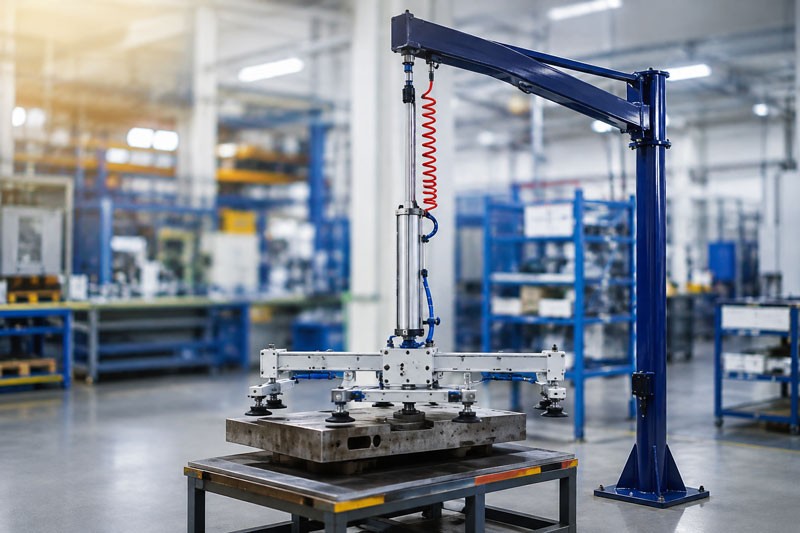
An industrial manipulator is a mechanical handling system designed to help operators lift, move, position, rotate, or otherwise manipulate loads in industrial environments.
Unlike a conventional hoist, which is primarily used to lift a load vertically, an industrial manipulator is designed to give the operator greater control over the movement of the workpiece.
Depending on the design and application, a manipulator can be used to handle heavy, bulky, awkward, or difficult-to-position components while reducing the physical effort required from the operator.
Industrial manipulators are widely used in manufacturing, assembly, machine loading, metal processing, automotive production, packaging, and other material handling applications.
Manual lifting and repetitive material handling can place significant physical demands on workers.
According to OSHA, lifting and lowering heavy objects, bending, reaching, pushing, pulling, and repetitive handling are recognized ergonomic risk factors in material handling operations. Engineering controls and powered equipment can help reduce these physical demands.
An industrial manipulator provides a mechanical solution between fully manual handling and fully automated material handling.
Instead of replacing the operator, the manipulator assists the operator.
The operator controls the movement while the equipment supports the load.
This approach can be particularly useful when:
The same component must be handled repeatedly
Loads are too heavy for comfortable manual handling
Components are bulky or difficult to grip
Operators need to position parts accurately
A production process requires frequent lifting and repositioning
The workpiece needs to be rotated or tilted during assembly
The basic concept is relatively simple.
The manipulator supports the load through a mechanical arm, balancing mechanism, or lifting system. A suitable end effector is then used to connect the equipment to the workpiece.
The operator controls the manipulator to move the load within its working area.
The end effector can vary significantly depending on the application.
Common options include:
Mechanical clamps
Vacuum grippers
Magnetic grippers
Hooks
Custom gripping tools
Application-specific fixtures
This is one of the most important aspects of industrial manipulator design.
The manipulator itself is only part of the handling solution.
The gripping system must also match the shape, weight, center of gravity, surface condition, and movement requirements of the workpiece.
A hoist is an excellent solution when the primary requirement is lifting and lowering a load.
However, many manufacturing processes require more than vertical lifting.
For example, an operator may need to:
Pick up a component
Move it horizontally
Rotate it
Position it inside a machine
Align it with another component
Release it at a specific location
An industrial manipulator can be configured around these types of movements.
This makes manipulators particularly useful for ergonomic material handling and workstation applications.
Industrial manipulators can be configured for a wide range of applications, including:
Machine Loading
Assist operators in loading and unloading components from CNC machines and other production equipment.
Assembly
Position components accurately during assembly operations.
Metal Handling
Move metal parts, sheets, frames, and other heavy components.
Automotive Manufacturing
Handle automotive components and assemblies during production.
Packaging
Move cartons, containers, and other packaged products.
Repetitive Production Handling
Reduce the physical effort associated with repetitive lifting and positioning.
The exact configuration should always be selected according to the actual load and working conditions.
There is no single manipulator configuration that is suitable for every application.
Important factors include:
Load weight
Load dimensions
Center of gravity
Required working radius
Vertical lifting range
Required rotation or tilting
Workstation layout
Frequency of operation
Type of gripping tool
Available power or compressed air
Required mounting method
A proper application assessment is therefore an important step before selecting equipment.
Industrial manipulators provide a practical way to improve ergonomic material handling without completely automating the operator's task.
By combining mechanical lifting assistance with application-specific gripping tools, they can help operators handle heavy or awkward workpieces more efficiently and with less physical effort.
For manufacturers dealing with repetitive lifting, positioning, machine loading, or component handling, an industrial manipulator can be an effective addition to the production process.
Looking for an industrial handling solution? Contact XUDRO with your load weight, dimensions, working range, and application requirements.